

Sore lower back pain tends to arrive without much warning. You bend to pick something up, sit too long at your desk, or wake one morning with a sharp pull that radiates straight down your leg. For some people it fades in a few days. For others, it’s the beginning of a longer conversation with their spine, one that involves disc herniation, nerve involvement, and a recovery plan that actually fits the injury.
The lumbar spine carries an enormous mechanical load. It absorbs impact, supports the core, and flexes through hundreds of daily movements. According to the National Institute of Neurological Disorders and Stroke, low back pain is one of the most common causes of job-related disability and a leading reason people miss work in the United States. Most cases resolve with conservative care. Some don’t, and understanding why determines how you treat them.
At BioSyntrx Medical Center in San Francisco, we’ve worked with patients dealing with every variation of lumbar pain over more than 25 years of clinical practice. Jean Terry, our clinical healthcare educator, has helped compile this guide based on what our orthopedic and physical medicine team most often explains to patients in consultation. For an overview of the musculoskeletal and specialist services we provide, visit our orthopedic and multi-specialty care services page.
What Is a Herniated Disc and Why Does It Hurt?
The spine’s vertebrae are cushioned at each level by intervertebral discs. Each disc has a tough outer ring called the annulus fibrosus and a soft gel-like center called the nucleus pulposus. When the outer ring weakens or cracks, the inner material can push outward. That’s the herniation. At the lumbar levels, L4-L5 and L5-S1 being the most common, this often brings the herniated material into contact with a nearby nerve root.
The pain isn’t just local. It travels wherever the irritated nerve leads, typically down the buttock and into the leg. That’s the pattern most people recognize as sciatica. Physical therapy treatment of sciatica addresses this by reducing nerve compression through targeted positioning, mobility work, and lumbar stabilization. Treatment for sciatica through physical therapy is among the most consistently supported approaches for disc-related nerve pain in the clinical literature.
“A herniated disk occurs when some of the softer material inside the disk pushes out through a crack in the tougher exterior. This can irritate or compress nearby nerves and result in pain, numbness or weakness in an arm or leg.”
Not everyone with disc changes on imaging feels pain. Some people have significant herniations with no symptoms at all. Others experience severe nerve pain from a relatively minor bulge. The direction of the herniation and how close it comes to the nerve root matters more than size alone. That’s why clinical evaluation, not just imaging, drives accurate diagnosis.
What Symptoms Come with a Lumbar Herniated Disc?
Symptom patterns vary by herniation level, but these are the most consistent presentations we evaluate in clinical practice:
- Sharp or burning pain in the lower back, buttock, or down one leg
- Numbness or tingling in the foot, calf, or thigh
- Muscle weakness that makes lifting the foot or standing on tiptoe difficult
- Pain that worsens with sitting, coughing, or bending forward at the waist
- Sore lower back that stiffens overnight and loosens with slow, gentle movement
- Relief when lying flat or shifting body position
- Pain that radiates along one specific line rather than spreading diffusely
How to Fix a Herniated Disc in the Lower Back?
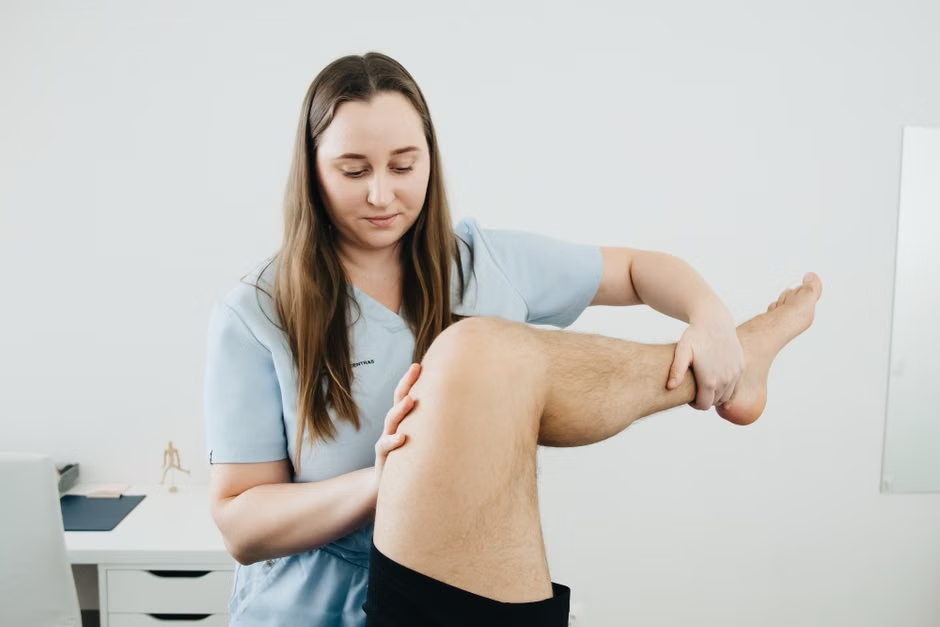
Most lumbar herniations improve without surgery. Conservative care is the starting point for almost everyone. The approach combines activity modification during the acute phase, anti-inflammatory medications to quiet nerve irritation, and physical therapy to restore movement and rebuild protective muscle support. Surgery is reserved for patients who don’t respond after 6 to 12 weeks of structured conservative treatment, or who develop progressive neurological deficits such as increasing leg weakness or loss of bladder and bowel function.
The most important early decision isn’t which treatment to choose. It’s whether to stay gently active rather than rest completely. Bed rest prolongs recovery. Guided movement, even simple walking, maintains disc hydration, reduces nerve sensitization, and preserves the muscle function the lumbar spine depends on for stability.
How Long Does a Small Herniated Disc Take to Heal?
For most small herniations, patients notice meaningful improvement within 4 to 6 weeks. Full recovery, including resolution of nerve-related symptoms, often takes 6 to 12 weeks. The disc itself rarely returns to its original shape, but the extruded material can shrink as the body gradually reabsorbs it, and nerve inflammation subsides as pressure decreases.
Recovery pace depends on herniation size and location, your age, your activity level, and whether you begin rehabilitation promptly. In our clinical experience, patients who start physical therapy within the first two weeks consistently recover faster than those who rest passively and wait. Waiting without structured rehab almost always extends the timeline unnecessarily.
How to Relieve Herniated Disc Pain in Lower Back at Home
Home management isn’t about enduring pain. It’s about creating the right conditions for the disc and nerve to settle while you pursue proper clinical care. These strategies align with evidence-based rehabilitation guidelines and are consistent with what we recommend at first evaluation:
- Modify your sitting habits. Avoid extended sitting. Stand every 20 to 30 minutes. Use a lumbar support cushion that maintains your spine’s natural inward curve.
- Ice first, then heat. Ice during the first 48 to 72 hours reduces acute inflammation around the nerve. After that, gentle heat relaxes surrounding muscle spasm without aggravating the disc.
- Walk gently and consistently. Short, flat walks maintain disc hydration and reduce stiffness. Start with 10 minutes and build gradually as your symptoms allow.
- Avoid disc-loading positions. Bending forward at the waist, deep bucket seats, and twisting under load all concentrate stress at the lower lumbar levels.
- Sleep on your side with a pillow between your knees. For a herniated disc at L4-L5, this keeps the spine in a neutral alignment and reduces tension on the nerve root overnight.
- Start physical therapy early. Treatment of sciatica through physical therapy, including nerve mobilization and lumbar stabilization exercises, produces substantially better outcomes than rest alone.
Treatment for Herniated Disc in Lower Back
Physical therapy is the foundation of conservative disc care. A skilled therapist builds a program specific to your herniation level and symptom pattern. The goal is reducing nerve sensitivity while rebuilding endurance in the muscles that protect the lumbar spine from repeated injury.
Medications including NSAIDs reduce inflammation around the nerve. A short course of oral corticosteroids can quiet an acute flare when pain is severe. Muscle relaxants address secondary spasm that develops as the body guards the injured area. None of these correct the disc itself, but they create a workable window for active rehabilitation.
Epidural steroid injections deliver corticosteroid directly to the affected nerve root when pain is severe enough to prevent movement. Relief isn’t permanent, but it can allow a patient to begin the physical therapy that would otherwise be impossible to tolerate.
Surgery, typically a microdiscectomy, removes the disc material pressing on the nerve. Most patients see rapid improvement in leg symptoms post-procedure. The clear indication is persistent neurological deficit or pain that hasn’t responded after three months of structured conservative care.
“For most people, a herniated disc will heal on its own over time. With nonsurgical treatment and physical therapy, the majority of patients recover fully within weeks to several months.”
Not every lower back and leg pain presentation is a disc problem. Knee ache treatment sometimes overlaps with lumbar care when altered gait mechanics from a knee or hip injury place extra stress on the lower lumbar levels. Similarly, patients with hand numbness or wrist pain need evaluation to distinguish carpal tunnel and treatment requirements from referred lumbar nerve symptoms, since these conditions can coexist in the same patient. Rheumatoid arthritis treatment follows a completely different clinical path and requires rheumatologic evaluation before any assumption that a disc is the primary driver. Multi-specialty evaluation, which our team at BioSyntrx Medical Center provides, ensures the correct diagnosis is driving treatment rather than the other way around.
Signs Herniated Disc Is Healing
Recovery doesn’t announce itself loudly. The progression is gradual, and it’s easy to miss unless you know what you’re watching for. Nerve-related symptoms almost always lag behind local back pain improvement. That’s normal physiology, not a sign that something is wrong.
- Leg or foot symptoms fading before back pain fully resolves
- Pain becoming more localized, pulling back toward the lower back rather than radiating further down the leg
- Fewer bad days and a longer window between flares
- Improved tolerance for sitting, standing, and walking without triggering symptoms
- Returning strength in a foot or leg that was noticeably weak
- Sleeping through the night without being woken by pain
The absence of symptoms doesn’t mean full healing is complete or that unrestricted activity is safe. It means the acute phase has passed. Structured rehabilitation at this stage shifts toward rebuilding load tolerance and teaching the spine to move safely, which is exactly what prevents recurrence down the line.
When Should You See a Doctor for Lower Back Pain?
Not every episode of back pain requires immediate clinical attention. But certain signs call for evaluation rather than a wait-and-see approach at home:
- Leg weakness that is progressing rather than staying stable or improving
- Loss of bladder or bowel control (this requires immediate emergency evaluation)
- Numbness in the inner thighs or groin area
- Fever alongside back pain
- Pain following significant trauma
- Symptoms that don’t improve after 4 to 6 weeks of conservative home management
Early evaluation allows healthcare providers to intervene before conditions worsen, helping patients avoid prolonged treatments and unnecessary risk. Clear communication between patient and provider during the diagnostic process is how accurate diagnosis happens, and accurate diagnosis is where every effective treatment plan begins.
Lower back pain from a herniated disc is one of the more disruptive things the body puts patients through, but the recovery outlook is genuinely positive when care is prompt and grounded in evidence. Understanding what’s happening at the tissue and nerve level, respecting the nerve’s slower healing timeline, and committing to active rehabilitation over passive waiting, all of these shift the outcome. If your symptoms are progressing, recurring, or not following the expected pattern, that’s the moment to bring in a specialist. Accurate diagnosis, coordinated care across specialties, and a practical treatment path forward are what our team at BioSyntrx is built to provide.
